
Surge Disk perforation clean-up
Our own packer, disk and gauges: a sudden underbalance cleans the perforation tunnels and measures productivity at first flow.
- Run with
- The perforating string
- Records
- The well's response, on gauges
- Gives
- Productivity index and skin
- Principal
- None: all Streamlines-owned
APPLICATIONS
Where it is applied
- New perforationsTunnels cleaned at the moment the disk breaks
- Re-perforationDamaged or plugged intervals
- Low-pressure reservoirsThe cushion fluid sets the pressure difference
- Productivity assessmentGauges and fluid levels record the response
- Artificial-lift designThe measured inflow sets the lift method
- Before stimulationShows whether the well needs it
THE QUESTION IT ANSWERS
Are the new perforations clean, and what is the well's real productivity?
Run with the perforating string: a packer, a surge disk and downhole gauges, with a cushion fluid above the disk. Breaking the disk creates a sudden pressure difference that surges reservoir fluid through the perforation tunnels and cleans them, while the gauges record the well's response.
When to run it
- New perforations
- A lift decision that needs productivity data
- A stimulation decision that needs productivity data
HOW IT WORKS
Run, break the disk, measure
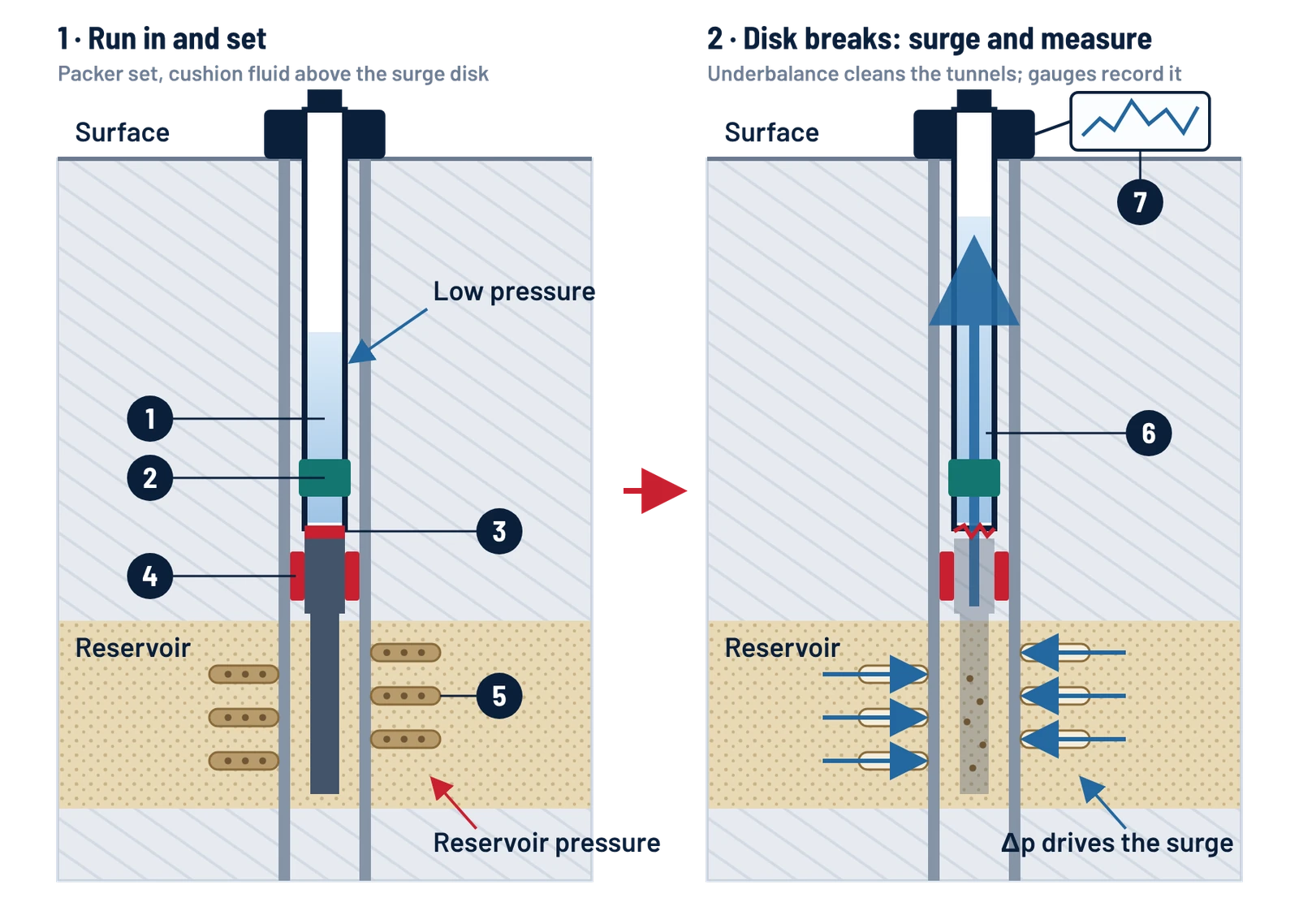
- 1Run and set. Packer, disk and gauges on the string; cushion fluid sized for the designed underbalance.
- 2Break the disk. The surge carries debris and crushed rock out of the tunnels into the wellbore.
- 3Measure. Gauge and fluid-level data are interpreted for productivity index and skin.
- The parts: cushion fluid (underbalance), downhole P/T gauges, surge disk, packer, plugged perforation tunnels, surge flow after rupture, and a surface fluid-level read-out.
Cleaner perforations and the data to decide
- Cleaner perforationsHigher-conductivity tunnels at first flow
- Productivity and skinFrom the gauge response
- Lift sizing dataThe data to size artificial lift
- A stimulation decisionWhether a stimulation job is needed at all
- One ownerPacker, disk, gauges and interpretation are all Streamlines-owned, with no third-party principal
WHERE IT FITS
Perforate, measure, size, decide
- PERFORATESurge Disk run with the perforating string
- MEASUREProductivity index and skin from the gauge response
- SIZEArtificial lift sized on the measured response
- DECIDEWhether a stimulation job is needed at all
WHY IT PAYS · PUBLISHED SOURCES
Clean tunnels, measured productivity
+20 → −1.2
Dynamic underbalance takes perforation skin from about +20 to −1.2, and the published wells needed no post-perforation stimulation.
> US$150,000 per well
Saved where acid stimulation was no longer required, in four of five wells.
+20–40% liquids
From rigless re-perforation as stimulation in the Gulf of Suez, on four platform wells.
+50% at Ninian
Rate against forecast; 87 against 17–52 MMcf/d at NAM; injectivity 18,000 against 12,000 bbl/d in SE Asia.
MEASURE WHILE YOU CLEAN
Gauges run with the string measure the underbalance actually achieved and confirm the design; the same data give productivity index and skin for the lift or stimulation decision (PDO, SPE-216441-MS).
Published case histories · Egypt first
Results reported by operators and vendors in the sources listed below. They are third-party results, not Streamlines' own.
| Where · when | What was done | Published result | Source |
|---|---|---|---|
| Egypt · Gulf of Suez, GUPCO & Dragon Oil · 2023 | Dynamic-underbalance re-perforation of damaged intervals on four low-drawdown platform wells | Tunnel clean-up up to 97%; liquids +20–40%; more than 2,000 bopd added across the four wells | SPE-214238-MS |
| Oman · PDO deep tight gas · 2023 | DUB perforating with a fast gauge run on the guns ahead of fracturing | Measured underbalance matched design; treating pressures fell; one zone needed no fracture at all | SPE-216441-MS |
| USA · Brady field, Anadarko · 2002–04 | Dynamic-underbalance guns from only 400 psi static underbalance | 5.2 MMcf/d at skin −1.17, against offsets at 1–5 MMcf/d with perforation skin above +20 | Oilfield Review |
| China · Tarim Basin, Sinopec · 2014 | Dynamic underbalance with perforating-shock modelling | Twofold productivity index versus conventional prediction; negative skin | SLB case study |
Published dynamic-underbalance results: the Surge Disk system uses the same mechanism, with Streamlines’ own packer, disk, gauges and interpretation.
SOURCES
- SPE-214238-MS
- SPE-216441-MS
- Bakker et al., Oilfield Review
- SLB case study, Tarim Basin
- SLB case study, SE Asia
- Halliburton, Cameroon, 2016
Name one new perforation job.
We reply with the packer, disk and gauge programme and the interpretation you will receive.