
PTA
Pressure-transient analysis
Log-log derivative diagnosis of permeability, skin, boundaries and drainage volume.
Build-up, drawdown and gradient surveys on dual quartz gauges, interpreted for permeability, skin and boundaries.
APPLICATIONS
THE QUESTION IT ANSWERS
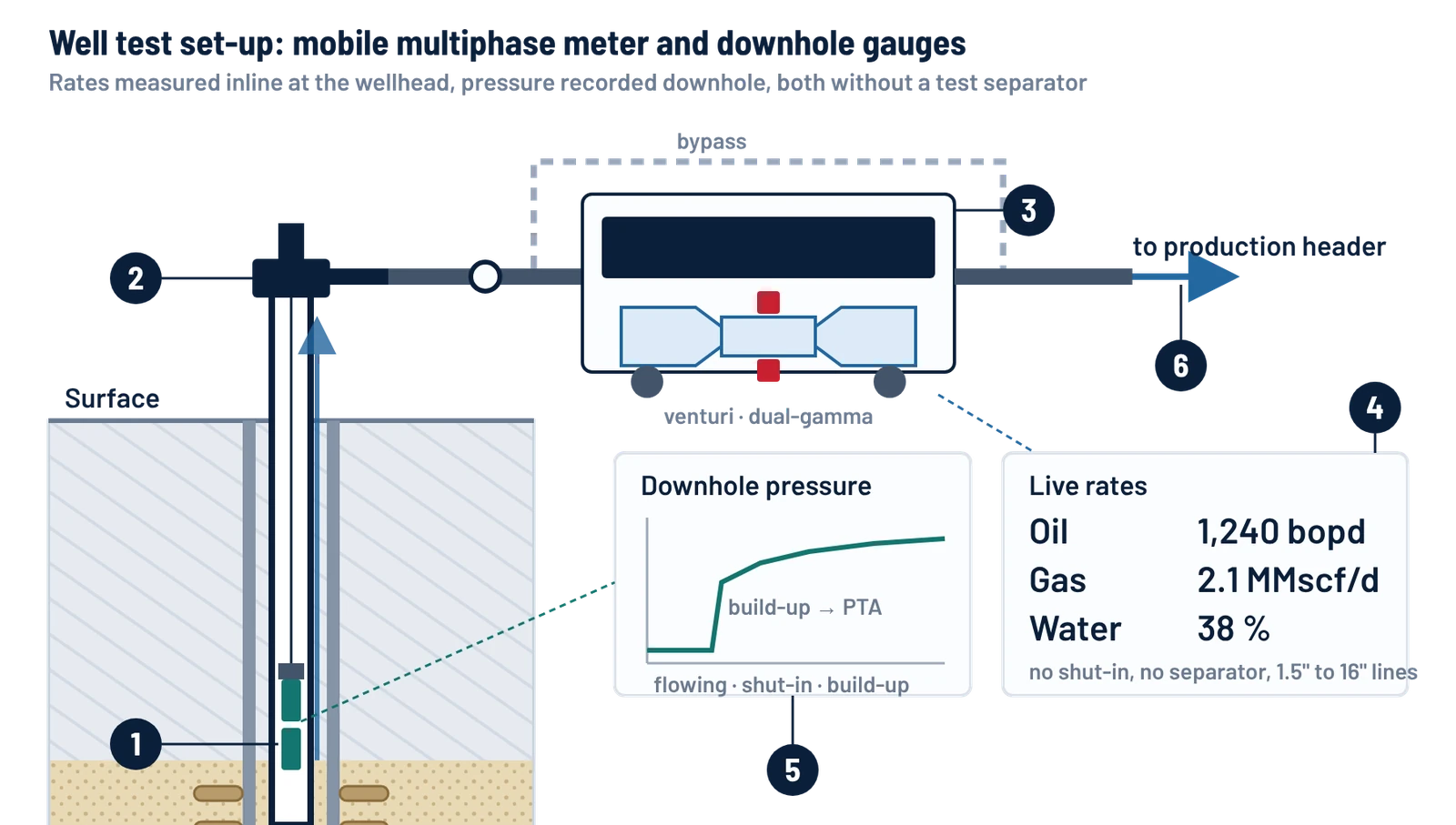
Our engineers design the test, interpret it and turn it into decisions for the reservoir and the well. Dual quartz gauges hang near the perforations and record the flowing and shut-in pressures the transient analysis needs.
What the analysis returns
HOW IT WORKS
DESIGN AND INTERPRETATION
PTA
Log-log derivative diagnosis of permeability, skin, boundaries and drainage volume.
RTA
Extracts kh, connected volumes and EUR from daily data without shut-ins.
VIRTUAL METERING
Virtual metering fills per-well rates between tests.
WELL MODEL
Well models calibrated to the measured pressures and rates.
| Surveys | Build-up, drawdown, static and flowing gradient |
|---|---|
| Gauges | Dual quartz, memory or surface read-out |
| Ratings | Standard and HPHT, 15,000 and 20,000 psi |
| Calibration | Every 6 months or 20 runs |
| Carriers | Bomb hangers and bundle carriers |
| Pumping wells | Echometer surveys |
WHERE IT FITS
WHY IT PAYS · PUBLISHED SOURCES
Skin or water?
Time-lapse pressure-transient analysis separates skin damage from water invasion, so stimulation money is not spent on a water problem.
Results reported by operators and vendors in the sources listed below. They are third-party results, not Streamlines' own.
| Where · when | What was done | Published result | Source |
|---|---|---|---|
| Egypt · WDDM, Nile Delta (BG) · 2013 | Time-lapse PTA on permanent downhole gauge data across groups of control wells | Rising skin identified as the main cause of productivity loss in low-liquid producers; intervention choice guided | SPE-164668-MS |
SOURCES
We design the survey with you and return the interpretation, the calibrated model and the decision it supports.