Gel conformance and water shut-off
Unwanted water has a source, a path and a chemistry that can close it: conformance control on injectors and shut-off on producers, designed from diagnosis first.
- Injectors
- Conformance control: fix where water goes in
- Producers
- Water shut-off: limit where it comes out
- Chemistry
- Bulk gels, microgels, delayed systems, RPMs
- Gate
- Diagnosis before any treatment
APPLICATIONS
Where it is applied
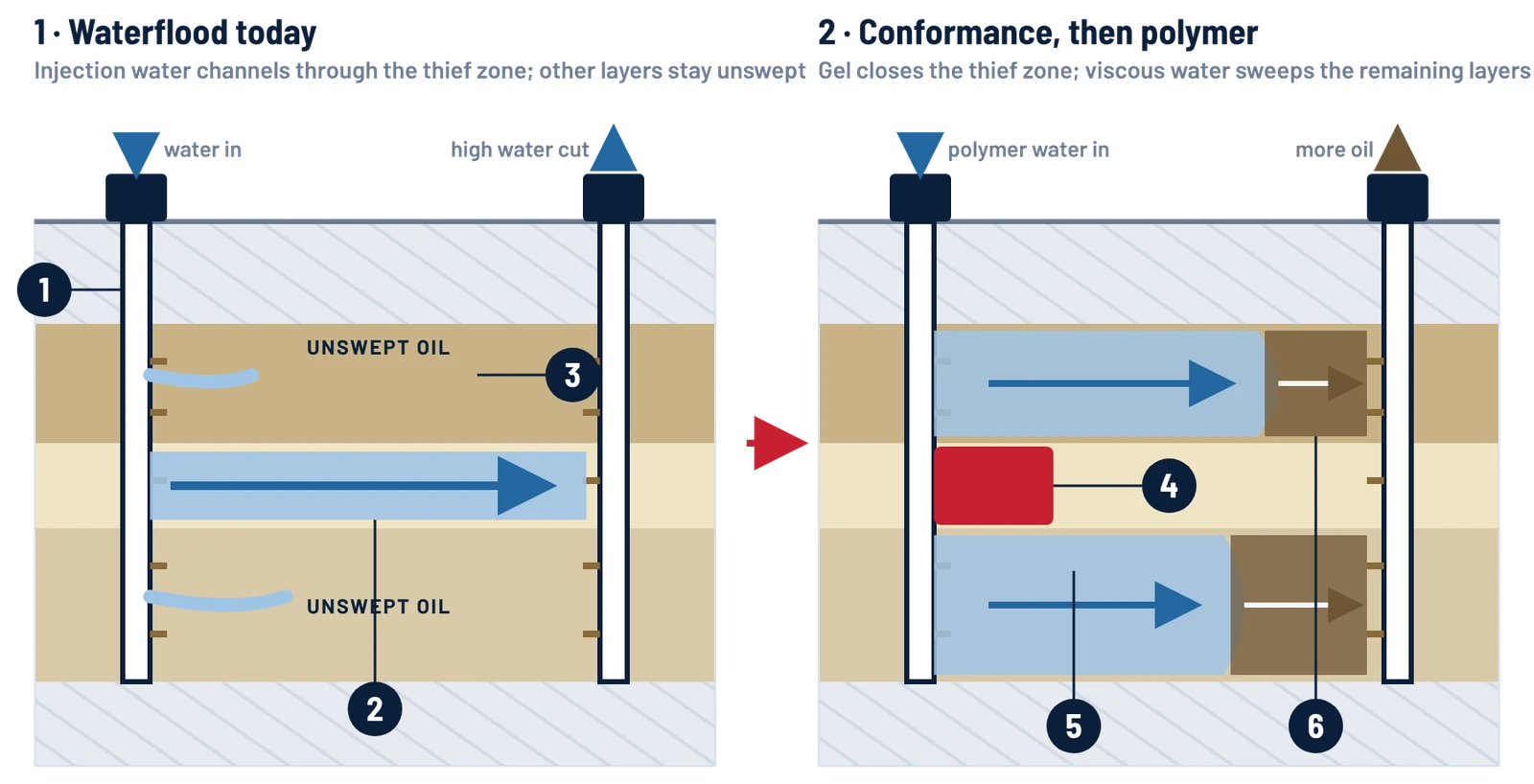
- High water cut from channelling or high-permeability streaks
- Injectors losing water to thief zones
- Fracture communication between injector and producer
- Coning near the wellbore
- Floods to be de-risked before polymer injection
Where is the water coming from, and how is it getting there?
Coning, channelling, fractures and casing leaks each need a different answer, and gel pumped at the wrong one is chemistry wasted with confidence. Diagnosis comes first: production and injection history, PLT and noise logs, and pattern analysis.
Match the product to the feature
Near-wellbore shut-off
Polymer crosslinked in place, where the feature is at the completion: strong, fast and placed shallow by design.
Deep placement
Kinetically or thermally triggered systems that travel with water-like viscosity before they set, for thief paths away from the wellbore.
In-depth conformance
Nanogels, microgels and expandable microgels that penetrate matrix and fine features, swelling or aggregating in place.
Where zones cannot be isolated
Relative permeability modifiers reduce water mobility while leaving oil paths open.
Diagnose, dimension, pump, measure
- 1Diagnose. Water source and path from production and injection history, logs and pattern analysis.
- 2Choose. The chemistry family from the physics of the feature, inside its temperature, salinity and lithology envelope.
- 3Dimension. Volume from the feature size; placement from injectivity and isolation options.
- 4Agree success. Water cut, profile change and oil response agreed before pumping.
- 5Measure. Response against the criteria; the diagnosis updated by what the well says back.
Conformance treatment before polymer flooding cures severe heterogeneity and de-risks the flood; conformance during polymer injection corrects problems that emerge with time.
Diagnosis is what makes a shut-off pay
+~4,000 bopd
At zero water cut: a Gulf of Suez rigless shut-off and re-perforation built on diagnosis of the rising oil–water contact, US$100,000 under plan.
Result reported by the operator and service company in the source below. It is a third-party result, not Streamlines’ own.
Related
Name one water problem.
We reply with the logs to run first and the treatment the evidence points to.