
Autonomous inflow and outflow control: AICV and AOCV
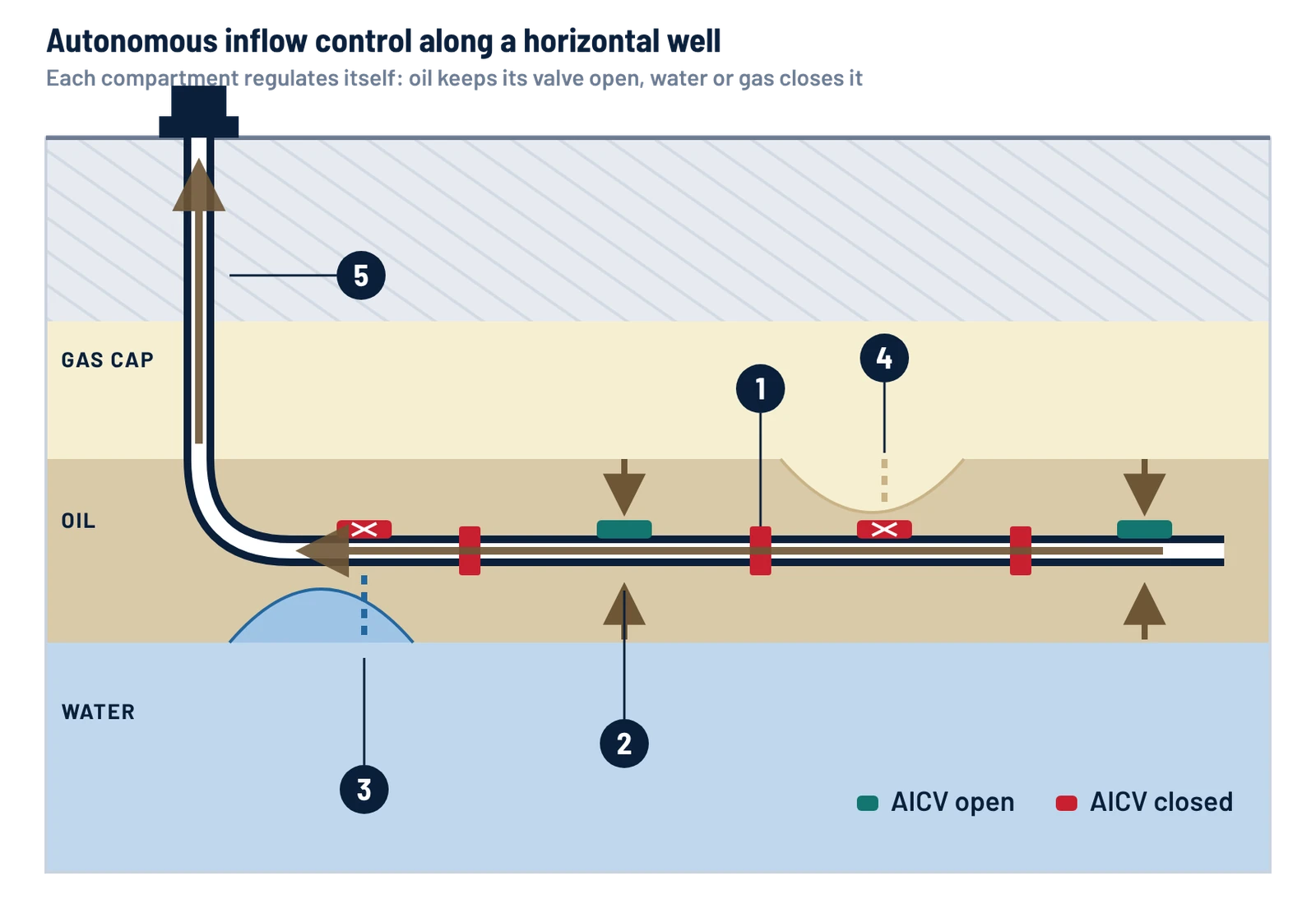
Water and gas shut off at the point they enter, with no electronics, control lines or intervention: autonomous inflow control valves on producers, and their outflow counterpart that distributes injection evenly across every zone.
- Producers
- AICV: chokes water, gas and steam
- Gas wells
- Gas AICV: restricts water, passes gas
- Injectors
- AOCV: near-constant flow per zone
- Deployment
- With the completion, or retrofitted
APPLICATIONS
Where it is applied
- Water shut-off in coning and channelling producers
- Gas shut-off in mature and high-GOR fields
- Gas reservoirs where water breakthrough threatens the well
- Retrofit into existing vertical wells
- Injection conformance with outflow control valves
- Field-scale water-control programmes
Why does the water win once it breaks through?
Early water or gas breakthrough in high-permeability zones, coning that drives water cut past 90% and bypassed oil are common to most mature fields. A passive ICD restricts every fluid equally, so once water breaks through it takes the path anyway; an autonomous valve chokes the unwanted phase progressively as the water cut rises.
Pure fluid mechanics, no electronics
Autonomous inflow control
Flow through the valve creates a viscosity-dependent pressure on an internal piston: viscous oil keeps it open, thin water or gas closes it. It reopens if the compartment recovers.
For gas reservoirs
Stays open for gas and condensate while restricting water from the sections where it breaks through.
Autonomous outflow control
On injectors, the opening shrinks as differential pressure rises, holding near-constant flow per zone so thief zones stop taking the water.
New wells and retrofits
Installed with the completion in tubing or screens, with swell packers between compartments; vertical, deviated and horizontal; retrofittable into many existing completions.
Diagnose, design, install, evaluate
- 1Candidate screening. PLT and noise-log evidence shows which intervals the valves should govern.
- 2Compartment design. Valve count, spacing and swell-packer positions from the logged inflow profile.
- 3Installation. With the completion, or as a retrofit, executed by Streamlines with the principal’s engineering behind us.
- 4Post-job evaluation. Water cut, GOR and injection profiles measured against the baseline.
Streamlines works with InflowControl (Norway), developer of the AICV®, Gas AICV® and AOCV®.
From one well in 2015 to field-scale programmes
2015
First AICV installation worldwide, offshore in the GCC; still performing well five years later.
90+ wells
Four-year water-control review documenting sustained performance at portfolio scale.
2025
Gas AICV launched: described as the first autonomous flow-control valve designed for gas reservoirs.
Results reported by the technology principal. They are third-party results, not Streamlines’ own.
Related
Name one well that is watering out.
We reply with the logs to run and whether autonomous valves fit the completion.