EOR applications
Recover the oil the waterflood leaves behind: polymer and surfactant flooding, nanobubble and biochemical IOR, taken from screening and laboratory work on your fluids to a gated pilot and field roll-out.
- Polymer flooding
- 8–20% incremental recovery reported
- Typical cost
- US$3–6 per incremental barrel
- Biochemical IOR
- Nanobubbles and protein–surfactant complex
- Programme
- Screen, laboratory, pilot, roll out
APPLICATIONS
Where it is applied
- Mature waterfloodsHigh water cut and stalled recovery
- Viscous oilsPolymer corrects an adverse mobility ratio
- Residual oil trapped by capillary forcesSurfactant systems
- Sandstones with claysEngineered-water injection
- Smaller and mature assetsSingle-well huff-and-puff
- Injection wells losing injectivityMaxStim Fusion stimulation and clean-ups
When should a waterflood become a chemical flood, and when should it stop?
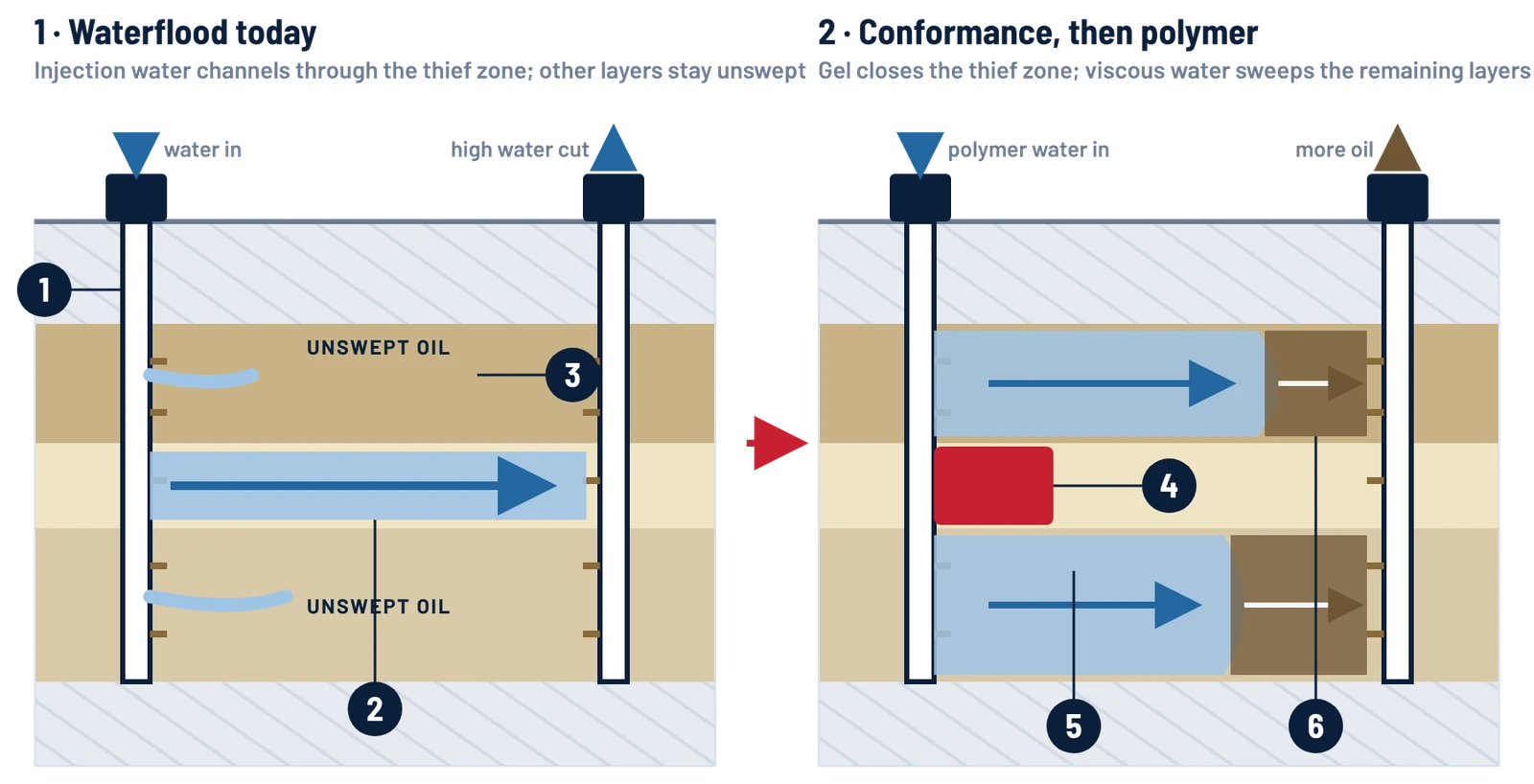
Water is thinner than oil, so it fingers through and recovery stalls around a third of the oil in place. Polymer corrects the mobility ratio; surfactants lower interfacial tension to release residual oil. The programme answers when to start, and when to stop.
Four ways to move more oil
Mobility control
Standard, high-temperature/high-salinity and structured polyacrylamides that stiffen the flood front and recover bypassed oil.
Residual-oil mobilisation
Surfactant–alkali–solvent systems where interfacial tension is the target, screened on your crude and brine.
Change the water, not the plant
Injection water with adjusted salinity and ions shifts wettability in sandstones with clays, using the injection system already in place.
Low-cost add-on
Nanobubble-charged water and a protein–surfactant complex lower interfacial tension and clear water blocks; started at pilot scale on a running flood.
Screen, test, pilot, roll out
- 1Screening. Reservoir and field assessment: which patterns, which chemistry, what prize.
- 2Laboratory. Selection and compatibility on the field’s own brine and crude.
- 3Pilot design. Pattern, injection skid, surveillance plan and the gates the pilot must pass.
- 4Pilot with gates. Injectivity, water cut and oil response measured at every gate.
- 5Field roll-out. Expanded pattern by pattern, with injected viscosity audited at the wellhead.
EOR and conformance polymers are supplied through SNF, for which Streamlines is authorised reseller in Egypt. Conformance treatment ahead of the flood protects it from thief zones.
Results from floods and treatments
8–20%
Incremental recovery reported for polymer flooding, across 350+ chemical-EOR applications worldwide.
13,000+ bbl/d
Incremental EOR oil from a South American multi-province polymer programme built pattern by pattern.
+176%
Well #A oil in the 15 months after a biocatalyst PSC treatment, against before; water cut on Well #B fell from 67–80% to 23–42%.
Figures reported by the technology principals and in field results compiled by Streamlines. They are third-party results, not Streamlines’ own.
Related
Name one waterflood.
We reply with the screening we would run and what a pilot would have to prove.